The RTS Link (Johor–Singapore): What to Know
The Johor Bahru–Singapore RTS Link explained — opening date, route, capacity, expected fares and what the train actually changes for cross-border commuters in 2026.
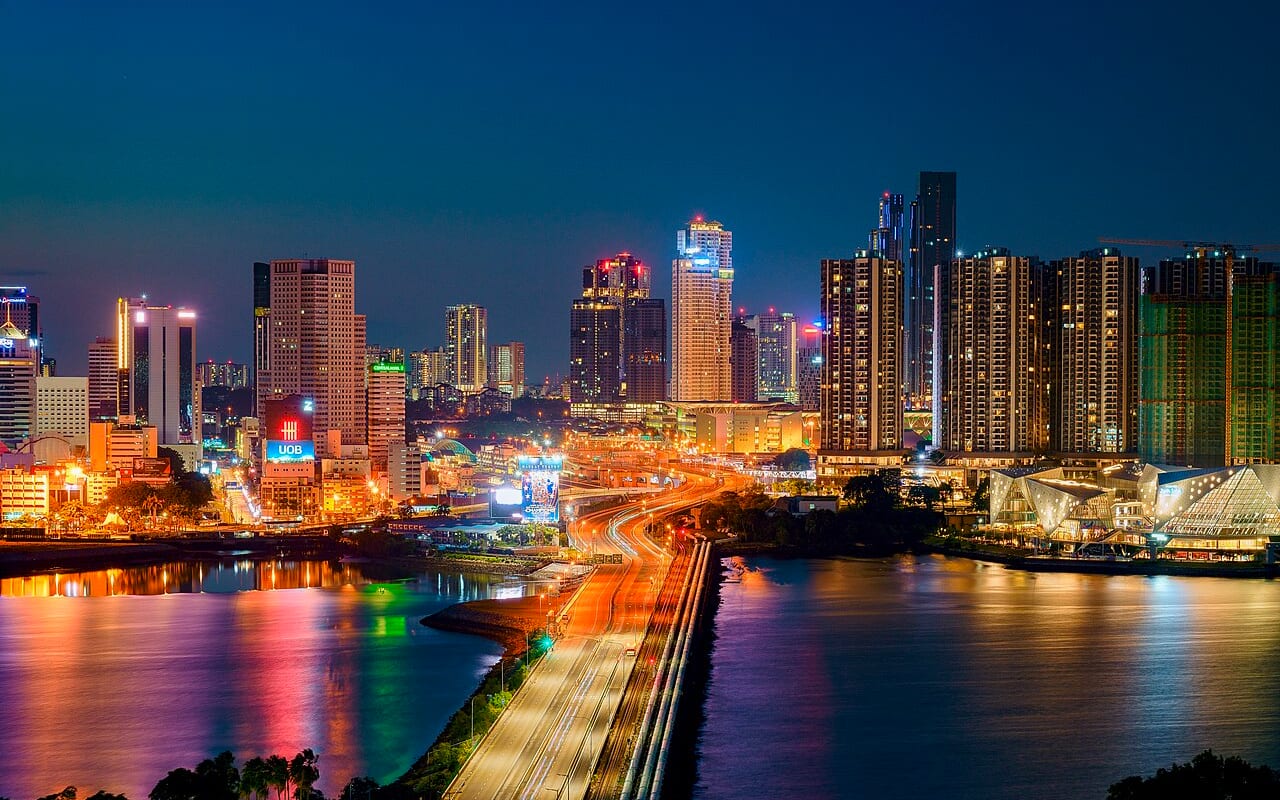
For anyone living in JB and crossing into Singapore — or thinking about it — the RTS Link is the single biggest infrastructure change in a generation. It’s a short cross-border train that, in principle, turns the daily Causeway nightmare into a five-minute ride. This guide covers what’s actually confirmed as of May 2026, what’s still projected, and who it really helps.
If your interest is the broader trade-off, read Johor Bahru vs Singapore living — the RTS is the variable that changes that whole equation.
What the RTS Link is
RTS stands for Rapid Transit System Link. It’s a standalone Light Rail Transit (LRT) line — not part of Singapore’s MRT or any Malaysian rail network — running across the Strait of Johor on its own 25-metre-high bridge, parallel to the existing Causeway.
It connects just two stations:
- Bukit Chagar in Johor Bahru (near the existing JB Sentral / city-centre CIQ area)
- Woodlands North in Singapore (connected to the Thomson–East Coast MRT line)
The cross-strait ride is roughly 4 km and takes about five minutes end to end.
When does it open?
This is the question everyone asks, so here’s the honest status as of May 2026.
The project is targeted to be completed by end-2026, with passenger service projected to commence from around January 2027. That’s the latest official framing — Malaysia’s transport ministry and the operating company have both pointed to late-2026 completion and early-2027 service.
Treat “early 2027” as the realistic commuter date, not “end 2026.” Completing construction and running paying passengers are two different milestones, and large cross-border rail projects rarely open the day construction finishes.
Construction progress as of around April–May 2026:
- Malaysia side: roughly 93% of infrastructure complete, including Bukit Chagar Station and the Wadi Hana depot (per MRT Corp).
- Rail systems (trains, signalling, power): around 56% complete (per the operating company, RTSO).
- Singapore side: structural works for the station and CIQ largely done by April 2026; systems testing slated to begin around September 2026.
So: civil works are nearly there, but the systems and testing phase — the part that gates a safe opening — was still mid-stream in spring 2026. That’s consistent with a “service from early 2027” reading.
Capacity and frequency
The line is built for serious throughput. At peak it’s designed to carry up to 10,000 passengers per hour per direction, with trains arriving roughly every 3.6 minutes at peak. For context, that’s a meaningful chunk of the estimated 300,000-plus people who cross the Causeway daily — and it’s all designed to be absorbed by a four-car shuttle running on a tight headway, with no driver fatigue or vehicle queue to slow it down.
The first train was unveiled in a joint Singapore–Malaysia ceremony, and trains are being delivered and tested through 2026 ahead of service. The fleet, depot (Wadi Hana, on the JB side) and signalling all have to pass integrated testing before paying passengers board — which is the real gate on the opening date, not the visible station structures.
What about fares?
Fares are not finalised as of May 2026 — and this is one area where you should ignore any “confirmed price” you see floating around.
Official fares are expected to be announced in the second half of 2026, ahead of launch. Press reporting and operator commentary have pointed to a likely one-way fare in the region of RM15–22 (roughly S$5–7). Take that as an indicative range from reporting, not a published figure.
Even at the top of that range, the pitch holds: it’s expected to beat the all-in cost of driving across — fuel, tolls, the Malaysian road charge, and especially Singapore’s VEP daily fee, which rises to S$50 per car per day from 1 January 2027. For a daily commuter, the train maths looks favourable against driving.
The immigration advantage
The genuinely clever part isn’t the train — it’s the immigration design. RTS uses co-located, single-point clearance: you clear both countries’ immigration at your departure station before boarding. When you arrive on the other side, you walk straight out. No second queue.
That removes the worst feature of the current crossing, where you queue twice and any single bottleneck cascades. With one-stop clearance at the origin, the five-minute ride is actually five minutes — not five minutes plus an unpredictable queue.
What it actually changes — and what it doesn’t
Be clear-eyed about who benefits. The RTS Link transforms the commute if you live and work near its two endpoints:
- Live near Bukit Chagar / JB city centre — walkable or short ride to the JB station.
- Work near Woodlands North — or somewhere with an easy Thomson–East Coast Line connection on the Singapore side.
If that’s you, the daily Causeway grind essentially disappears. This is why property interest around the Bukit Chagar / city-centre corridor has been strong — proximity to the RTS endpoint is now a real value driver. (If you’re buying with this in mind, see buying property in Iskandar Malaysia.)
What it doesn’t do:
- It won’t help much if your Singapore workplace is far from the Thomson–East Coast Line — you may still face a long onward leg.
- It won’t move cars, lorries or motorcycles. Drivers still use the Causeway and Second Link, with all the border-crossing rules that apply.
- It’s two stations only — not a network. It’s a cross-border shuttle, not a metro.
The bottom line
The RTS Link is real, far along, and genuinely transformative for the right commuter profile — but the right framing as of May 2026 is “construction nearly done, passenger service projected for early 2027, fares not yet set.” If you’re planning a move or a property decision around it, build in schedule slack and don’t bank on a price that hasn’t been published.
For how the RTS reshapes the cost-vs-commute decision, read Johor Bahru vs Singapore living. For where to base yourself near the endpoints, see best areas to live in Johor Bahru.
Got a specific question about timing a move around the RTS opening? Get in touch.
Sources (May 2026): LTA RTS Link project page, Wikipedia: JB–Singapore RTS, paultan.org on fares, Mothership on project status.
About the author
Chris Tan lives and works in Johor Bahru, Malaysia, helping people relocate to and buy property in the Iskandar region. Questions about your move? Get in touch.
Keep reading
 Travel & Explore
 Best Time to Visit Malaysia: Weather, Seasons & Crowds
When to visit Malaysia depends on where you go. A region-by-region guide to monsoons, haze, heat, school holidays and 2026 festival dates from someone who lives here.
2 Mar 2026
 Travel & Explore
 Crossing the JB–Singapore Border: A Complete Guide
How to cross the Johor Bahru–Singapore border in 2026 — Causeway vs Second Link, VEP and road charges, QR/autogate clearance, peak times, and car vs bus vs motorcycle.
8 Mar 2026
 Travel & Explore
 Bak Kut Teh in Johor Bahru: Where to Go
A local guide to bak kut teh in Johor Bahru — Shoon Huat, Hwa Mei, Kota Tinggi style, the difference between herbal and peppery broth, and rough 2026 prices.
6 Mar 2026
 Travel & Explore
 Beaches Near Johor Bahru
A local's guide to beaches near Johor Bahru — Desaru Coast, Tanjung Balau, Tanjung Piai and more, with drive times, rough 2026 costs and honest expectations.
11 Mar 2026
 Moving to Malaysia
 Best Areas to Live in Johor Bahru: A Neighbourhood Guide
Where to live in Johor Bahru — JB city, Bukit Indah, Iskandar Puteri, Mount Austin and more, compared by lifestyle, commute to Singapore, and who each suits.
7 Feb 2026
 Property & MM2H
 Buying Property in Iskandar Malaysia: A Foreigner's Guide (2026)
Can foreigners buy property in Johor? Yes — here's how it actually works in Iskandar Malaysia: rules, process, financing, fees, and the mistakes to avoid.
10 Feb 2026